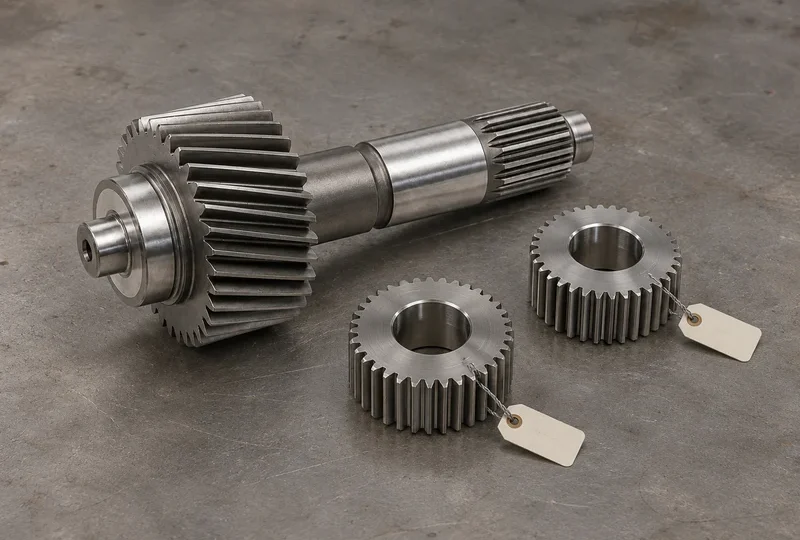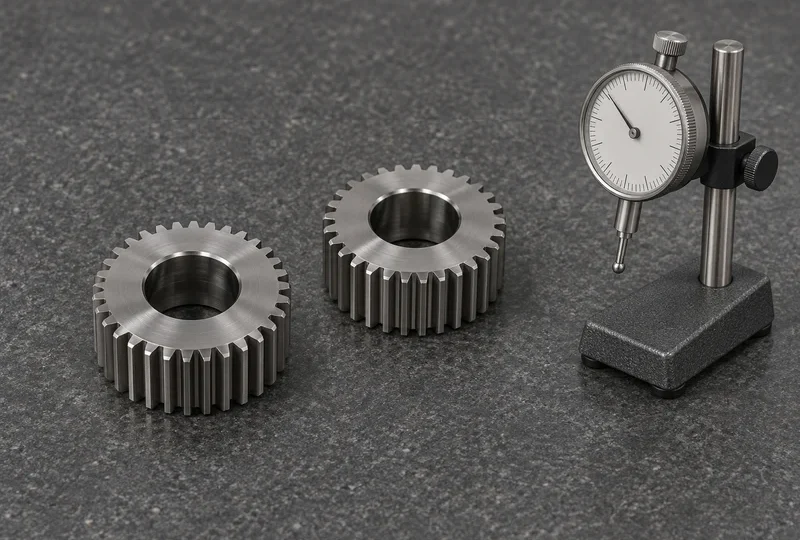



When you compare carburizing and nitriding for gears, start with the hardness profile the finished tooth needs and the amount of movement the process can tolerate. Carburizing is a candidate when the design calls for a hardened case formed by carbon diffusion and quenching. Nitriding is worth evaluating when the required layer can be achieved on a suitable substrate and the gear has little stock available for finishing after treatment.
How each route hardens the tooth
In a conventional carburizing route, carbon diffuses into the surface of a suitable steel at elevated temperature. The quench hardens the enriched case. Steel selection and the heat treatment cycle determine the condition of the core as well. If the gear will be ground, allow for the material removed from the hardened surface when setting the target case before finishing. See Bodycote’s atmospheric carburizing process description.
Nitriding introduces nitrogen into the surface. The alloy and process determine the resulting diffusion zone and whether a compound layer forms at the surface. The nitriding step generally requires no hardening quench. A designer may start with quenched and tempered stock to obtain the required core condition, then specify nitriding on a near-finished part. Check how the treatment temperature relates to the prior tempering condition and whether the part needs stress relief before final machining. See Bodycote’s gas nitriding process description.
Compare the requirements at the finished tooth
| Drawing decision | Carburizing review | Nitriding review |
|---|---|---|
| Hardness through the case | Define the required effective case depth with the specified hardness criterion and location after finishing. | Define nitriding hardness depth or other agreed depth criterion. Specify the compound layer condition if it matters to the application. |
| Core support | Check steel hardenability, section size and the core requirement after the specified cycle. | Check the initial core condition and whether it will be retained after nitriding. |
| Dimensional change | Plan for movement during heating and quenching. Check profile, lead and runout after finishing. | Allow for growth and stress relief. Check final geometry and account for any stock removed by polishing. |
Use the applicable drawing or process specification to identify the depth measurement and hardness threshold. A case depth reported against one criterion cannot be compared numerically with a nitriding depth reported against another. Agree on where to section the gear if flank and root requirements differ, and on how to verify surfaces that must stay soft or untreated.
A proposed switch after a grinding problem
Consider a carburized gear whose distortion leaves too little stock on one flank to clean up during grinding. A proposal to nitride the part addresses the quench step, but it also changes the material and hardness profile assumptions. Start by recording where the distortion occurs and how much stock the finishing operation needs. Check whether the proposed nitrided material can meet the contact and root loading requirements at the available depth, and whether the specified surface layer is compatible with the final finish.
If a supplier offers the same surface hardness for both routes, ask for a depth profile at an agreed location, the intended core condition and a dimensional check at the final stage. The drawing owner can use those results to define the scope of any revised specification or sample validation.
For a custom gear feasibility review, send the drawing and the current heat treatment note. Include the finished tooth requirements, the areas that must be protected, and any observed dimensional change with its measurement stage.