

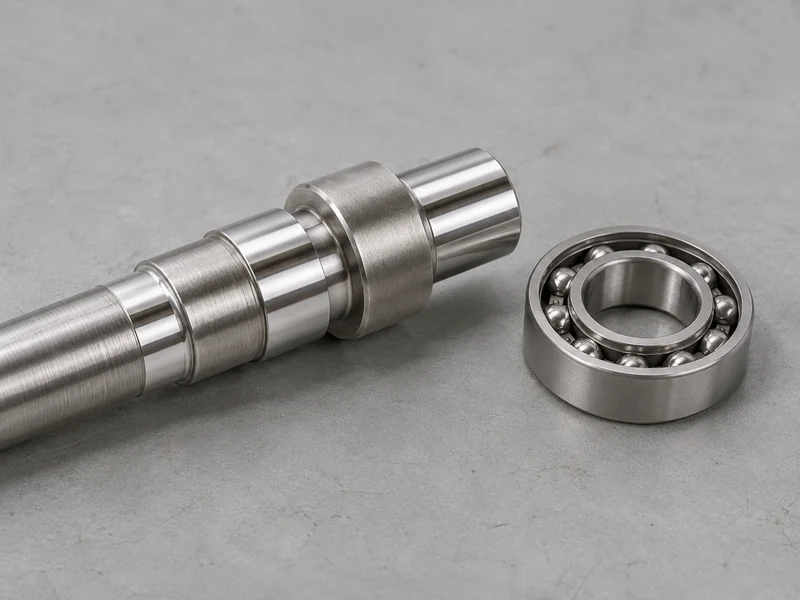
A motor shaft bearing fit should be selected from the bearing’s load condition, internal clearance, temperatures, shaft construction and mounting arrangement. A familiar tolerance such as k6 is not a complete selection method. The same motor can require different decisions at its two bearing positions.
The objective is to retain each ring appropriately while preserving the intended operating clearance or preload and allowing the assembly’s required movement. Start with the bearing manufacturer’s guidance for the actual bearing designation, then translate the approved arrangement into a measurable shaft drawing.
Identify rotation relative to the load
“The shaft rotates” is incomplete information. What matters for fit selection is how the load direction moves relative to each bearing ring. In a common arrangement with a rotating inner ring and a load direction fixed relative to the housing, the loaded region moves around the inner ring.
SKF’s rolling-bearing guidance distinguishes stationary, rotating and indeterminate load directions. A ring exposed to a rotating load generally needs adequate interference to resist creeping on its seat. Variable load directions, shock and vibration require their own review; copying a light, steady-load example can miss those conditions.
Prepare a small sketch for each bearing. Mark inner-ring rotation, outer-ring rotation, radial load direction and any axial load. If the load direction changes through the motor’s duty cycle, record the operating cases rather than choosing the most convenient one.
Collect the inputs before selecting a tolerance class
| Input | Information to collect | Why it changes the decision |
|---|---|---|
| Bearing | Complete designation, bore, tolerance and clearance or preload arrangement | Nominal bore alone does not define the mating limits or internal condition |
| Loads | Magnitude, direction, shocks, reversals and duty cycle | Retention requirements depend on more than average load |
| Temperatures | Expected shaft, inner ring, outer ring and housing conditions | Differential expansion changes fits and operating clearance |
| Shaft | Material, solid or hollow section, seat geometry and surface requirements | The support’s compliance and expansion affect the installed condition |
| Arrangement | Locating and non-locating functions, axial movement and mounting method | The fit must work with the complete bearing arrangement |
Use the maker’s table applicable to that bearing type, size and load category. Record the assumptions beside the candidate fit so another engineer can reproduce the selection. If operating data remain uncertain, identify the candidate as provisional.
Check what interference does to the bearing
A tight shaft fit can expand an inner ring and reduce the bearing’s internal clearance. Operating temperature differences can alter it further. NSK separates initial, residual and effective clearance: before mounting, after mounting and during operation. Those are different conditions, so an unmounted clearance designation does not by itself establish the running condition.
Do not treat “use C3” as a universal correction for a tight fit. Have the bearing arrangement checked using the actual interference range, temperature assumptions and selected bearing. A clearance choice that suits one combination may not suit another.
A tolerance-stack example
The following invented dimensions illustrate arithmetic only; they are not a recommended motor-shaft fit. Suppose a shaft seat is allowed from 30.006 to 30.014 mm and the mating bore from 29.990 to 30.000 mm. The nominal arithmetic interference range is:
- Minimum: 30.006 − 30.000 = 0.006 mm.
- Maximum: 30.014 − 29.990 = 0.024 mm.
This establishes a dimensional stack, not the effective interference or remaining bearing clearance. Surface effects, ring and shaft deformation, and temperature still need consideration. Use the selected bearing’s actual limits rather than these example numbers.
Hollow shafts and thermal movement need an explicit check
A hollow seat has different radial compliance from a solid seat. Ask the bearing supplier to check the interference and ring expansion for the actual inner and outer shaft diameters. Do not transfer a solid-shaft recommendation without evaluating that change.
Also identify how the shaft accommodates thermal growth. Depending on bearing type and arrangement, axial displacement may occur within a bearing or at a sliding interface. Tightening both rings everywhere without checking that arrangement can defeat its intended movement. The fit decision belongs to the complete support design.
Write a drawing that manufacturing and inspection can use
Once the fit is approved, specify the shaft seat limits or the applicable tolerance designation and standard. Define the relevant form, surface and geometric requirements, shoulder location and fillet clearances. State the finished delivery condition so inspection is not inadvertently performed before an operation that changes the seat.
Agree the measurement method and sampling locations. Several diameter readings can reveal size variation, but they do not automatically establish every form or runout requirement. Those characteristics need the methods called for by the drawing.
Mounting verification should follow the bearing manufacturer’s procedure. Record the equipment and method, and check any specified endplay, preload or rotation condition. Avoid using assembly force as the only evidence that the seat dimension is correct.
Release each journal with its own decision record
For each bearing position, retain the selected bearing designation, load case, fit calculation, clearance or preload check, thermal assumptions and mounting requirements. If two journals use the same fit, the record should explain why their conditions support that choice.
For a motor-shaft manufacturing review, send TAITECH the shaft drawing, bearing references, solid or hollow section details, quantities and required inspection records. Mark any unapproved bearing-fit decision explicitly. The custom gear and shaft RFQ checklist can help organize the technical package before quotation.