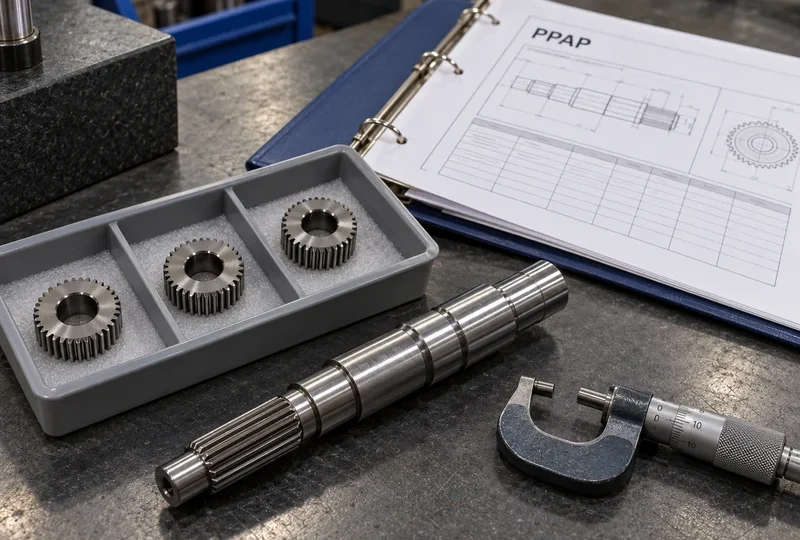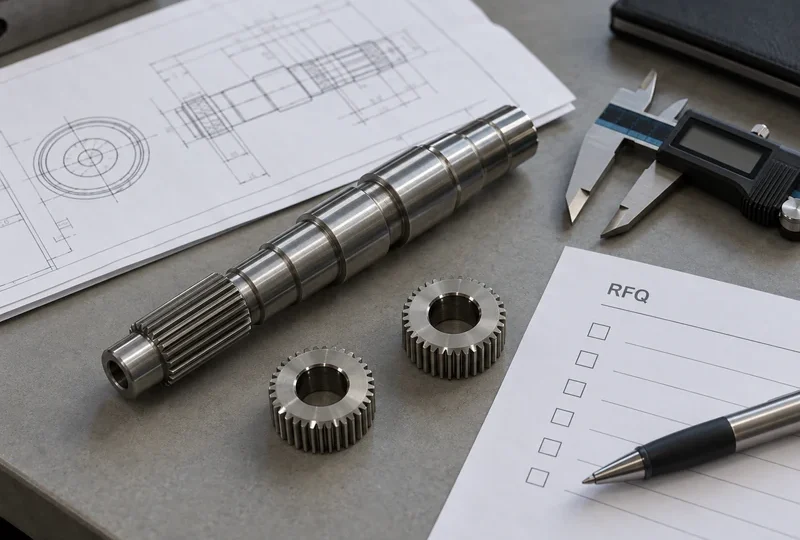


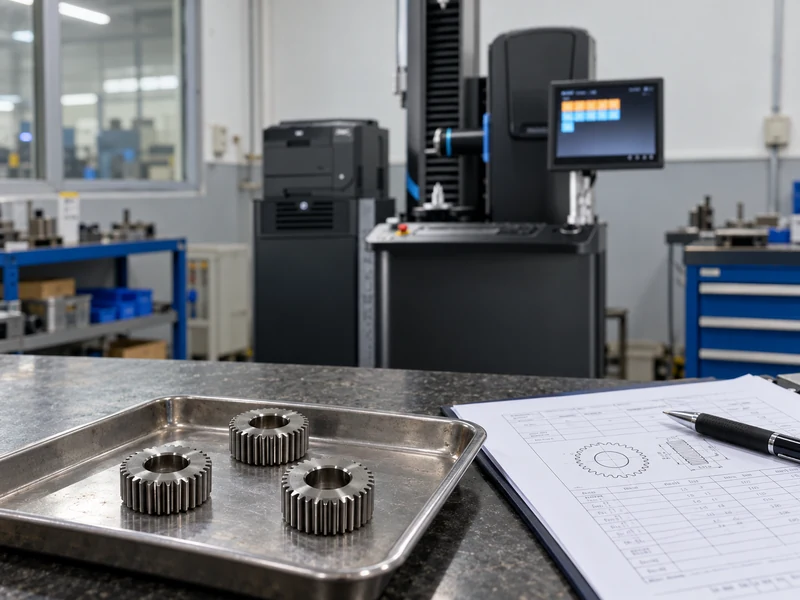
Choose a gear and shaft manufacturer by checking whether its proposed production route and inspection evidence fit your part. Start with the drawing, verify the contracting entity and manufacturing sites, review reports for comparable features, and use an agreed trial-order process before scaling up. A factory photograph or broad precision claim cannot answer those questions.
For OEM sourcing managers and supplier-quality engineers, gear shaft supplier qualification is a series of evidence-based decisions. The useful question is: can this supplier control the features, operations, and records required for this program?
Shortlist against the part you actually need
Define your must-have requirements before comparing suppliers. A shop that makes small spur gears may not suit a long, heat-treated helical shaft. Likewise, a supplier of complete gearboxes may not offer the drawing-controlled component supply you need.
Build the shortlist around part geometry, material, manufacturing condition, critical interfaces, inspection requirements, and production quantities. Ask each supplier to explain a plausible route for your drawing and identify any operation it would place outside its own facilities.
For a combined gear-and-shaft program, review the supplier’s gear and gear-shaft product scope alongside its custom manufacturing process. Product relevance establishes a reason to investigate further; it does not complete qualification.
Make the manufacturing and commercial responsibilities visible
A business may combine manufacturing and export trading while coordinating several production sites. Ask who contracts with you, who makes the part, who performs outside processes, and who releases the finished batch. Record these roles in the supplier file.
| Role to establish | Evidence to request | Question to resolve |
|---|---|---|
| Contracting and export entity | Business identity, quotation, contract details | Which entity owns the commercial commitment? |
| Manufacturing site | Site address and proposed operation list | Where will this part actually be made? |
| Outside-process provider | Named operation, approval method, incoming checks | How is outsourced work controlled? |
| Quality release owner | Named contact and release workflow | Who authorizes shipment and handles deviations? |
When a certificate is relevant, check its entity, manufacturing-site scope, validity, and authenticity through the appropriate verification route. Treat it as one part of the evidence. For automotive programs, identify the applicable customer requirements using the IATF customer-specific requirements register and the customer’s own supplier documents.
Connect the machine list to a proposed process route
Ask the supplier to walk through the part from incoming material to final inspection. For each critical feature, identify when it is created, which later operations may affect it, and where acceptance is verified.
Useful discussion points include access for gear cutting, support for a slender shaft, the relationship between heat treatment and final finishing, and the datums used across operations. Ask for explanations tied to the actual geometry. An equipment brand or machine count does not establish that a particular setup can achieve the drawing.
For outsourced heat treatment or finishing, review how the supplier communicates specifications, maintains batch identity, checks returned work, and handles a nonconforming batch. The issue to resolve is control of the route, including work performed beyond the final assembly or shipping site.
Read an inspection report with the drawing beside it
Request a redacted report for a comparable component, then trace several characteristics from the drawing to the reported results. Check part revision, sample identity, units, nominal values, limits, measured values, and the inspection method. Redaction should protect confidential customer information while leaving the method understandable.
For a gear shaft, select different feature types: a bearing journal, a geometric control relative to datums, and a gear-tooth requirement. Ask how the part is located and whether the reported method measures the requirement as specified.
NIST explains that metrological traceability belongs to a measurement result and involves a documented calibration chain with measurement uncertainty. Possessing a calibrated instrument alone does not establish traceability for every result made with it. That is why method and setup evidence matter alongside calibration records. See NIST’s metrological traceability guidance.
For your trial order, agree the reporting format in advance. If supplier and customer results disagree, compare datum setup, fixturing, measurement method, and part condition before deciding which manufacturing change is needed.
Use the quotation discussion to test technical communication
A useful supplier response separates accepted requirements, proposed alternatives, and unresolved questions. Give shortlisted suppliers the same controlled inquiry and compare how they handle missing or conflicting information.
- Do they identify the quoted drawing revision?
- Do they flag ambiguous gear data, datum references, or material notes?
- Do they describe exceptions before quoting a firm price?
- Do they separate sample, tooling, inspection, and recurring costs?
- Can they explain the conditions behind the proposed schedule?
A request for clarification can be a positive sign when it identifies a real risk. Score the quality and closure of the response, rather than rewarding an immediate “yes” to every requirement.
Run a focused remote or on-site review
Use the proposed process route as the agenda. Ask the team to demonstrate how it controls a drawing revision, identifies material, records an inspection result, and separates accepted parts from suspect material. Where confidentiality permits, follow a representative job through the records.
A remote review can help screen a supplier, but decide which risks need an on-site visit or additional evidence. For either format, record observations, supporting documents, open actions, owners, and closure dates. A tour without follow-up actions leaves the qualification decision difficult to defend.
Keep the review proportionate to the application and your customer’s requirements. A critical automotive shaft and a development fixture do not necessarily need the same approval path.
A practical supplier qualification scorecard
The following is an editorial evaluation tool, not a certification standard. Use “open,” “documented,” and “demonstrated” to distinguish a supplier statement from reviewed evidence and observed results. Decide which criteria are mandatory before scoring.
| Criterion | Evidence for your project | Decision before scale-up |
|---|---|---|
| Product and process fit | Proposed route tied to the drawing | Resolve operations with no credible route |
| Entity and site clarity | Consistent commercial and site records | Identify the responsible parties |
| Critical-feature inspection | Suitable methods and sample reports | Close measurement-method gaps |
| Outside-process control | Specifications, traceability, verification | Approve the proposed supply chain |
| Drawing and change control | Revision log and clarification closure | Agree notification and approval responsibilities |
| Trial performance | Accepted parts and agreed evidence | Close deviations before release |
| Commercial and delivery fit | Comparable quotation and release plan | Confirm scope, capacity assumptions, and terms |
If a numeric comparison is useful, assign 0 for no evidence, 1 for a supplier statement, 2 for reviewed documentation, and 3 for demonstrated project evidence. Set weights to reflect your application. Do not let a high total cancel an unresolved mandatory requirement.
Use a trial order to close the decision
Before placing the trial order, agree its purpose and acceptance criteria. A prototype may support design learning, while a production-intent trial evaluates the planned manufacturing route. Record any temporary process or tooling differences and their implications for the next approval step.
Review the delivered parts together with the required reports, packaging, labels, and drawing revision. Log deviations and corrective actions. A successful trial supports the next decision, but ongoing production still needs agreed controls, change notification, and supplier performance review.
To begin a discussion with Pan Nation, request a custom manufacturing review and provide the drawing, expected quantities, critical characteristics, and qualification requirements. Use the response to identify the evidence needed for your supplier approval process.