

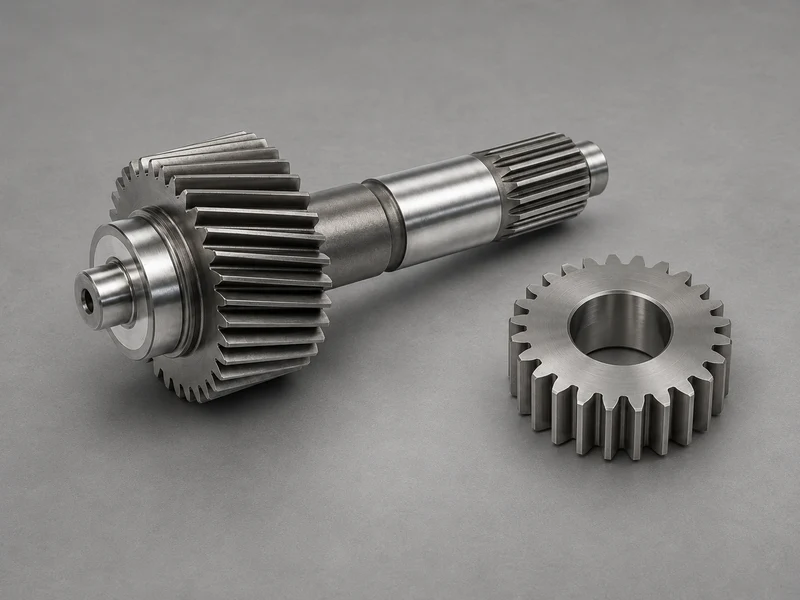
An integral pinion shaft carries the gear teeth and the bearing journals on one piece of material. A separate gear adds a joint between the hub and shaft. Start the choice with the assembly drawing. Trace the torque through the joint, then check how the finished parts will get past the bearings and into the housing.
What changes when the pinion becomes part of the shaft?
On the integral design, torque passes directly from the teeth into the shaft section. The transition next to the gear still needs a bending and fatigue review. Look at the fillet and nearby diameter changes. A small pinion can also leave little radial space for a bore and hub, making the one-piece route worth quoting early.
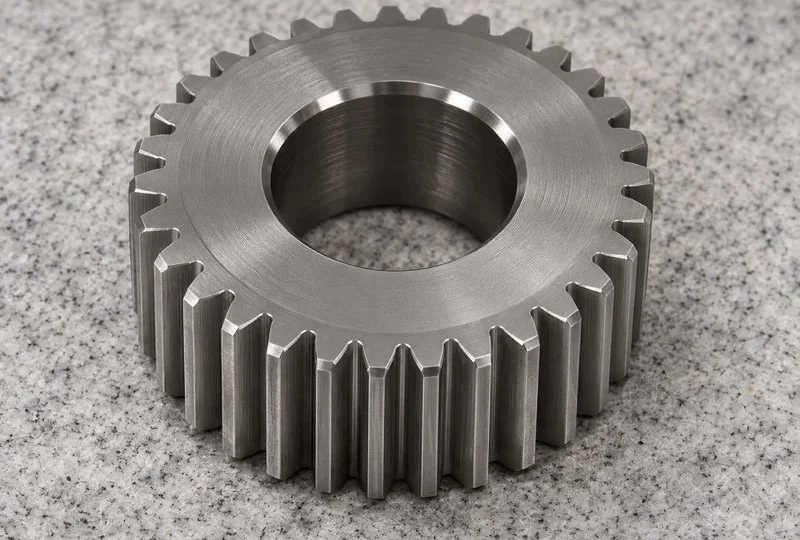
A separate gear gives the designer an interface to size. A spline, key or interference fit can transmit torque, depending on the design. Specify how the hub is located axially and radially. For a spline, include effective engagement, the mating fit and the conditions that govern flank loading. For a fitted hub, review the assembled bore and shaft stresses under the intended load and temperature. AGMA spline design and application guidance.
Check access with the finished geometry
A shoulder close to the teeth may leave too little room for the cutter or grinding wheel to run out. Ask the supplier to mark the approach and exit directions on a section through the pinion. The separate gear may be easier to finish on its own, but it then needs a bore datum and a way to verify the tooth location after assembly. Gear hobbing and tool access.
Decide which surfaces need hardening and how the shaft will be supported through finishing. An integral part requires a compatible material and process for both gear and shaft. With separate parts, you can specify their conditions independently and then verify the effect of joining on the final mesh alignment.
Score the two routes against your assembly
Use hard requirements first. If the pinion cannot pass through the housing on a one-piece shaft, resolve the assembly route before scoring cost or serviceability. For the remaining candidates, an illustrative ranking might assign 40% to installed alignment, 35% to replacement access and 25% to manufacturing access. Score each item from 1 to 5 using drawing or process evidence.
| Criterion | Integral design | Separate gear |
|---|---|---|
| Installed alignment | 4 | 3 |
| Replacement access | 2 | 5 |
| Manufacturing access | 3 | 4 |
| Illustrative weighted score | 3.05 | 3.95 |
Replace those scores with evidence from your own layout. Ask what locates the tooth relative to the bearing journals and which inspection step proves it. Include the hub fit and locating face in that tolerance stack for a separate gear.
Send both section drawings, torque cases, and the assembly and replacement sequence if you want the two routes reviewed together. Custom gear shaft inquiry.