

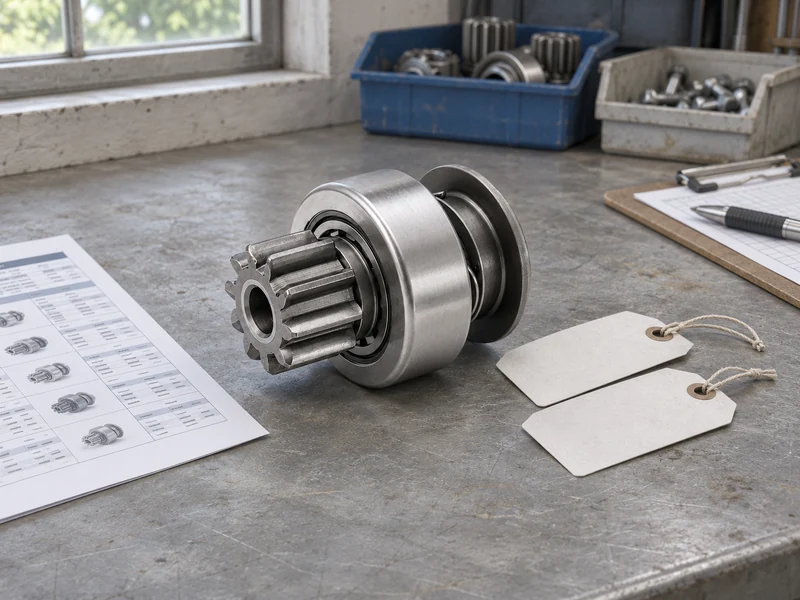
A starter drive cross-reference is a lead for verification, not proof of interchangeability. Before approving an equivalent, establish what each number identifies, preserve the original catalogue source, compare the actual interfaces and validate the candidate within a defined starter variant.
For wholesalers and remanufacturers, the most useful output is a controlled cross-reference record with an approval state. That record should explain why an equivalent was accepted and where its use is restricted, so the next purchasing team does not inherit an unsupported match.
Identify the level of the part number
Keep vehicle or engine references, complete starter references, OE drive references and supplier drive numbers in separate fields. A catalogue may cross-reference complete starter motors without saying that their loose drives are interchangeable. Do not carry an assembly-level equivalence down to an internal component automatically.
Preserve prefixes, suffixes, spaces where meaningful and leading zeros in the source record. Store identifiers as text in a spreadsheet so number formatting cannot silently change them. You may maintain a normalized search field, but keep the exact original alongside it.
Photograph the marking when it comes from a physical core. If a label is damaged or a character is uncertain, record the uncertainty instead of guessing the missing digit.
Record the source before following the match
| Field | Purpose |
|---|---|
| Original number and number type | Distinguishes the complete starter from the loose drive |
| Proposed equivalent | Identifies the candidate and supplier revision |
| Source | Catalogue owner, document or URL, edition and page or entry |
| Retrieval date | Shows when the purchasing team checked the reference |
| Relationship | Cross-reference, supersession, application listing or supplier proposal |
| Restrictions | Starter variants, production changes or other stated exclusions |
A supersession from A to B should be recorded in that direction with its stated conditions. Do not assume it proves B can always be replaced by A. A chain of several catalogue links is also not a substitute for checking the final candidate against the intended application.
Use dimensions to investigate conflicts, not to force agreement
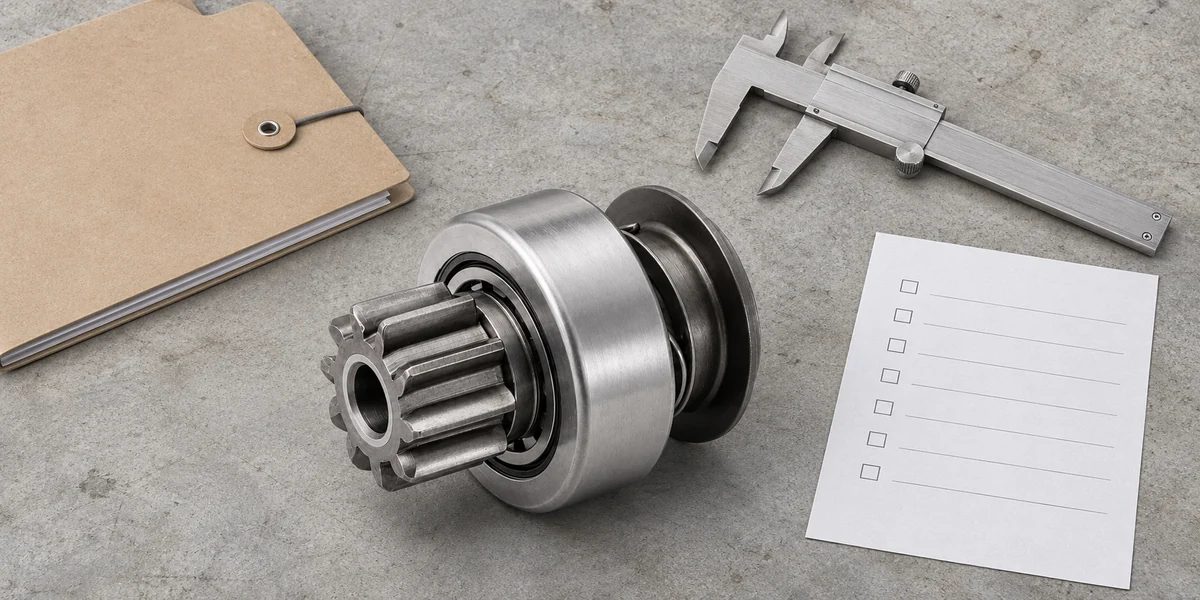
Manufacturer catalogues provide useful comparison fields. For example, the ZEN starter-drive catalogue distinguishes tooth count, pinion outside diameter, length, splines and rotation-related information. This older document is useful for understanding catalogue terminology; a current fitment decision needs the applicable current entry and supporting evidence.
When two sources disagree, compare the definitions behind the numbers. “Length” may refer to a different endpoint or component condition. “Rotation” needs a viewing convention. An apparent conflict may be a definition issue, but it may also identify a genuinely different part.
Create a difference list with the source value, candidate value, measurement basis and required decision. Do not average the values, round away a disagreement or select the larger dataset merely because it looks more complete.
Check the actual starter variant
A returned core is evidence of the assembly in front of you, which may have been repaired or modified. Confirm the manufacturer reference, relevant construction and mating components. Link the photographed drive to that specific core rather than to a general vehicle model.
The starter-drive selection guide covers the physical interface review. For cross-reference control, retain the resulting report IDs, sample identities and the exact variant covered by approval.
Use three approval states
The following state model is an editorial recommendation for a buyer’s database, not a manufacturer certification system.
| State | What it means | Permitted next action |
|---|---|---|
| Unverified | A catalogue, search or supplier has suggested a relationship | Request information or a sample; do not represent it as approved interchange |
| Conditional | Some checks are complete but a named requirement remains open | Complete the specified validation within the stated restrictions |
| Confirmed for defined scope | The agreed checks are complete and an authorized reviewer has approved the relationship | Order and label within the recorded starter-variant and revision boundary |
“Confirmed” should always lead to the evidence and approval scope. It should not become a permanent universal label independent of part revisions or application changes.
A conflict-resolution example
This is a fictional database example; the identifiers are placeholders, not real OE numbers. A buyer’s source maps drive A to candidate B. A second list links B to a starter family, but the physical core has a different engagement-interface detail from the candidate drawing.
The relationship remains conditional. The buyer records the interface conflict and requests the correct variant definition. If the supplier identifies a documented revision and the agreed dimensional and functional checks close the difference, the reviewer can confirm the relationship for that revision. Without that evidence, the correct outcome is an unresolved candidate, even if several websites repeat the same cross-reference.
Protect the approved record through purchasing and relabeling
Link the approved relationship to the supplier item, drawing revision, sample approval and package identification. Preserve traceability when creating a private-label SKU. A change in source, component revision or stated application should trigger review of the affected relationship.
For a TAITECH starter-drive enquiry, send the original and candidate references, catalogue sources, actual starter identification, photographs, difference list and order quantities. Ask for confirmed information and unresolved checks to be separated in the response before the cross-reference is used for bulk ordering.