

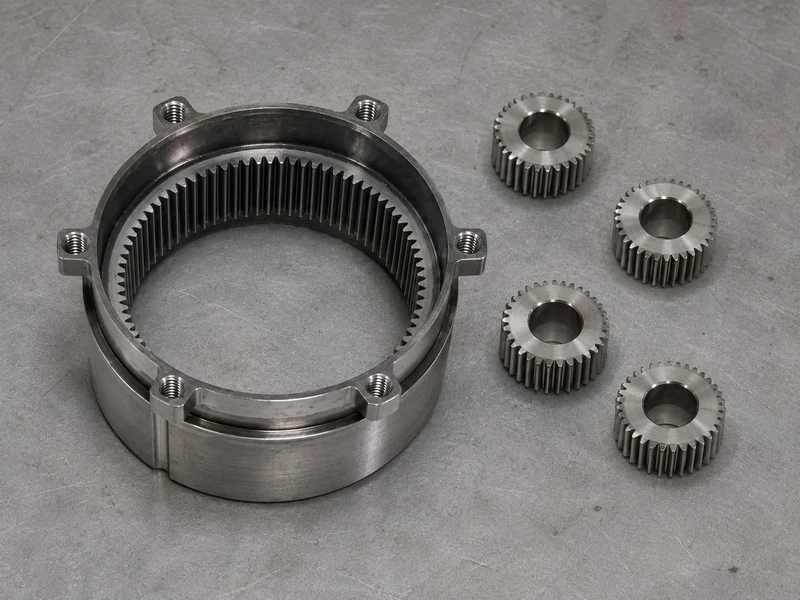
To calculate a planetary gear ratio, identify the sun, ring and carrier, then write down which member drives, which member delivers the output and which one is held. With a 24-tooth sun and a 72-tooth ring, holding the ring gives a 4:1 reduction from sun to carrier. Hold the carrier instead and the ring turns in the opposite direction to the sun.
These calculations apply to a simple planetary set in which each planet meshes externally with the sun and internally with the ring. For help identifying the parts, see the planetary gear component guide.
Use signed speeds on a common axis
Choose one viewing direction and use the same positive direction for all three members. Let ns, nr and nc be their speeds in rpm, and let Zs and Zr be the sun and ring tooth counts. Subtract the carrier speed from the other two speeds to describe motion in the carrier’s frame. In that frame the sun and ring speeds, weighted by their tooth counts, sum to zero.
Zs(ns − nc) + Zr(nr − nc) = 0
Solving for carrier speed gives nc = (Zsns + Zrnr) / (Zs + Zr). This is the simple planetary relation often called the Willis equation. See the MathWorks planetary gear model.
Same tooth counts, three different connections
Use 24 and 72 teeth and an input of +3,600 rpm in each example. The ratio in the last column is input speed divided by output speed. A minus sign indicates reversal.
| Member held | Input → output | Output speed | Signed ratio |
|---|---|---|---|
| Ring | Sun → carrier | 24 × 3,600 / 96 = +900 rpm | +4 |
| Sun | Ring → carrier | 72 × 3,600 / 96 = +2,700 rpm | +4/3 |
| Carrier | Sun → ring | −24 × 3,600 / 72 = −1,200 rpm | −3 |
If you reverse the input and output roles while keeping the same member fixed, take the reciprocal of the signed ratio. For instance, with the ring fixed, driving the carrier makes the sun turn four times as fast in the same direction.
When the ring can move
Suppose the sun is at +3,600 rpm and a second drive turns the ring at −300 rpm. The carrier then runs at (24 × 3,600 − 72 × 300) / 96 = +675 rpm. If the ring reaches −1,200 rpm while the sun speed stays the same, the carrier stops. The set has two independent member speeds, so a single input speed and the tooth counts leave the output undetermined unless you also specify a constraint or a second speed.
A quick check is to put the same speed into the sun and ring fields. The carrier should come out at that speed, since all three members can rotate together with no relative motion. If your sheet produces a different value, look at the signs and tooth-count references before using it to select motor speed.
What to put on the speed sheet
Give each operating mode its own row. Record the direction convention, input and output members, member held or second input, both tooth counts and the calculated speeds. Keep the load and torque cases beside that sheet for the separate strength review. The speed relation does not allocate real tooth loads among the planets. Their load sharing depends on how the set is built and supported.
For a component inquiry, attach the speed sheet, mating drawings and load cases, and identify the parts you want reviewed. Use the custom component inquiry form.