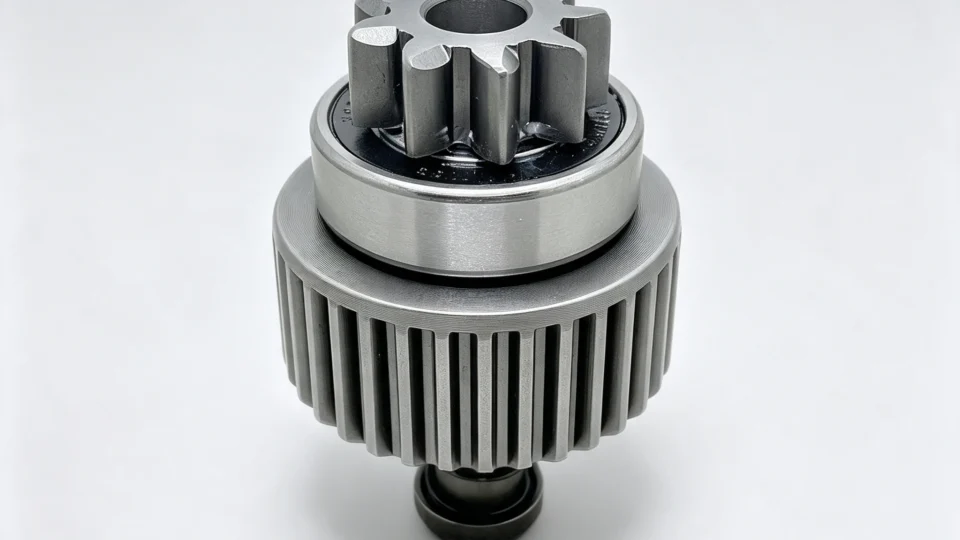


A gear shaft is a rotating mechanical element designed to transmit torque while supporting or integrating one or more gears. Unlike a simple shaft, its function is not limited to carrying rotational force. The gear section engages with another gear, transferring speed and torque through a mechanical drive system.
Depending on the application, a gear shaft may be manufactured as an integrated component or assembled from separate parts. Typical engineering considerations include shaft diameter, gear outside diameter, number of teeth, pressure angle, pitch diameter, keyway or spline geometry, and overall length.
In automotive starter systems, the same engineering principles apply to the drive assembly. The supplied technical material shows starter-drive configurations using a precision pinion, shaft, bearing assembly, and overrunning clutch. Typical specifications include 8–12 pinion teeth, 28–46 mm pinion outside diameter, 8–17 mm shaft diameter, and 52–78 mm overall length. These ranges vary according to the specific starter and application.
1.Why Does Your Gear Shaft Fail Even When the Gear Teeth Look Perfect?
A gear shaft can look acceptable during visual inspection and still fail in service. The real problems are often hidden in shaft diameter, tooth profile, concentricity, material hardness, or the fit between the shaft, gear, and bearing. For distributors and OEM buyers, this creates three costly risks: premature wear, installation problems, and inconsistent field performance. A poorly matched gear shaft may cause noise, vibration, excessive friction, or even transmission failure. The problem becomes more serious when different suppliers use different dimensions or machining tolerances for apparently identical parts. Correct material selection, precision machining, dimensional inspection, and application matching are therefore more important than appearance alone.
A gear shaft is a precision mechanical component that combines a rotating shaft with one or more gears to transmit torque and rotational motion. Correct selection depends on tooth geometry, shaft diameter, material, hardness, concentricity, dimensional tolerance, and application load. Pan Nation, backed by factory manufacturing capability, provides precision-machined components with OEM, ODM, and Customizable solutions for demanding applications.
Before choosing a Manufacturer or Supplier, it is useful to separate terminology from engineering requirements. The following sections explain what a gear shaft actually does, how it differs from similar terms, and which dimensions and quality factors matter in real-world production.
2.How Does a Gear Shaft Transmit Torque?
When rotational force enters the shaft, the gear section transfers that force to a mating gear. The resulting relationship between gear ratio, rotational speed, and torque determines the mechanical output. The shaft must therefore withstand both torsional stress and, depending on the structure, bending loads.
For a production buyer, the important point is simple: a gear shaft is a complete load-transmission component, not merely a shaft with teeth. A small error in tooth geometry or shaft alignment can affect the entire assembly.
- Tooth geometry controls engagement quality.
- Shaft diameter influences torque capacity and fit.
- Concentricity affects vibration and uneven wear.
- Material and heat treatment determine wear resistance and service life.
- Surface finish influences friction and bearing performance.
3.Gear Shaft vs. Ordinary Shaft
An ordinary shaft mainly transfers torque or supports rotating components. A gear shaft performs an additional task: it provides the controlled gear geometry required for torque transmission between meshing gears. This makes manufacturing accuracy significantly more demanding.
For example, a shaft can have the correct overall length but still fail to perform correctly if the gear runout, tooth profile, or shaft-to-bearing fit is outside specification. This is why professional production requires more than turning operations. It may involve CNC machining, gear cutting or forming, grinding, heat treatment, deburring, and dimensional inspection.
For B2B purchasing, the key question is not simply “Can the factory make this part?” It is “Can the factory repeatedly make the same part within the required engineering specification?” That distinction separates a capable Manufacturer from a trading-only Supplier.
4.Is It Gear Shift or Gear Shaft?
Gear shift and gear shaft describe different mechanical concepts and should not be used interchangeably.
A gear shift generally refers to the process or mechanism used to change gears in a transmission. In automotive language, “gear shift” may describe the driver’s gear-selection action or the associated mechanism.
A gear shaft, by contrast, is a physical rotating component. It carries or incorporates gears and transmits mechanical power. In a transmission, several shafts may exist, including input shafts, countershafts, main shafts, and output shafts.
| Term | Meaning | Typical Function |
|---|---|---|
| Gear Shaft | Rotating mechanical component | Transmit torque and rotational motion |
| Gear Shift | Gear-selection action or mechanism | Change the selected transmission ratio |
This distinction matters when communicating with an international Supplier. A purchasing inquiry that uses “gear shift” when the required component is a “gear shaft” can lead to incorrect quotations, drawings, or samples. For OEM and aftermarket sourcing, always provide the part drawing, application, critical dimensions, tooth specifications, and shaft interface whenever possible.
5.What Is a Main Shaft Gear?
A main shaft gear is a gear mounted on, integrated with, or mechanically associated with the main shaft of a transmission or other powertrain system. Its purpose depends on the specific design, but it generally participates in transmitting torque between the input and output sides of the system.
The main shaft is normally a critical load-bearing rotating component. Its gears must maintain accurate engagement with mating gears under changing torque and speed conditions. Consequently, gear alignment, shaft straightness, tooth accuracy, and surface hardness are important quality factors.
6.Which Specifications Should Buyers Check?
When purchasing a main shaft gear or related gear-shaft component, buyers should confirm the complete dimensional interface rather than relying on the product name.
- Number of teeth and tooth geometry
- Pitch diameter and outside diameter
- Shaft diameter and fit tolerance
- Overall length
- Keyway, spline, or other connection geometry
- Material grade and heat-treatment requirement
- Rotation direction and operating speed
- Required inspection and functional testing
For automotive starter-drive applications, the supplied product documentation identifies shaft diameter, pinion outside diameter, overall length, rotation direction, and 12V/24V application as important specifications.
7.What Is Another Word for “Gear Shaft”?
There is no single universal synonym for gear shaft. The correct term depends on the mechanical design and industry. Common related terms include geared shaft, shaft gear, gear-bearing shaft, transmission shaft, input shaft, output shaft, and main shaft.
However, these terms are not technically identical. An input shaft describes the shaft’s position and function in a powertrain. An output shaft describes where torque leaves the system. A main shaft describes a particular structural role. “Gear shaft” emphasizes the combination of shaft and gear functionality.
In starter applications, another related term is starter drive or Bendix drive. These assemblies normally contain more than a simple gear shaft. The technical product material identifies components such as a pinion gear, overrunning clutch, drive housing, and shaft & bearing assembly. The overrunning clutch helps prevent reverse rotation and protects the starter from overspeed after engine start.
8.What Are the Critical Gear Shaft Parameters?
For wholesale and OEM purchasing, dimensions should be evaluated as a system. A correct tooth count cannot compensate for an incorrect shaft diameter. Likewise, a correct shaft diameter does not guarantee reliable gear engagement.
| Parameter | Typical Starter-Drive Range | Engineering Consideration |
|---|---|---|
| Pinion Teeth | 8–12 | Application and mating gear dependent |
| Pinion Outside Diameter | 28–46 mm | Must match the application |
| Shaft Diameter | 8–17 mm | Must match the starter shaft interface |
| Overall Length | 52–78 mm | Model dependent |
| Rotation | CW / CCW | Clockwise or counterclockwise |
These figures are useful as reference ranges, not as universal replacement specifications. The supplied technical catalog specifically notes that dimensions vary by application and that shaft diameter must match the starter shaft.
Material, Heat Treatment, and Wear Resistance
Gear shafts operate under repeated mechanical loading. The gear teeth experience contact stress, while the shaft experiences torsional and bending loads. Material selection therefore needs to consider strength, fatigue resistance, wear resistance, and the required heat-treatment process.
The supplied starter-drive material emphasizes high-strength steel and heat treatment for improved wear resistance and service life. It also highlights precision machining of the pinion and high-precision shaft and bearing construction. :contentReference[oaicite:4]{index=4}
For buyers, the practical questions are: What material is being used? What heat treatment is applied? Which dimensions are inspected after treatment? And is the process stable from batch to batch? These questions directly affect long-term reliability.
9.How Should a Gear Shaft Manufacturer Control Quality?
A reliable Gear Shaft Manufacturer should control quality throughout the production process rather than depending only on final visual inspection. Critical dimensions need documented inspection methods and repeatable measurement standards.
- Incoming material inspection to verify raw-material consistency.
- Dimensional inspection of shaft diameter, gear dimensions, and overall length.
- Tooth-profile inspection where required by the application.
- Concentricity and runout control for rotating assemblies.
- Heat-treatment verification when hardness and wear resistance are specified.
- Functional testing for assemblies such as starter drives and overrunning clutches.
- Final inspection before shipment.
The Pan Nation product material specifies 100% inspection on key dimensions and functional performance for its starter-drive products. It also describes factory-direct supply, stable production capacity, competitive pricing, and on-time delivery as key manufacturing capabilities.
Why OEM and ODM Capability Matters
Standard catalog parts are not always enough for distributors, repair networks, and equipment manufacturers. Different markets may require different tooth profiles, dimensions, materials, packaging, branding, or assembly configurations.
An experienced Supplier should therefore be able to work from a sample, technical drawing, reference part, or application requirement. OEM production supports customer-specified designs and branding, while ODM cooperation can support product development based on an existing manufacturing platform. A Customizable solution is especially valuable when customers need private-label products or application-specific dimensions.
The supplied company material explicitly identifies support for OEM, ODM, and customized solutions to meet different market and application requirements.
10.How to Choose the Right Gear Shaft Supplier
For international buyers, the lowest unit price is rarely the most important purchasing criterion. The real cost includes sampling, rejected goods, installation failures, warranty claims, production delays, and emergency replacement orders.
A qualified Supplier should be evaluated against several practical criteria:
- Manufacturing capability: Can the factory control machining and assembly internally?
- Dimensional consistency: Are critical dimensions inspected systematically?
- Material control: Can the Supplier provide stable material and heat-treatment quality?
- Customization: Can the Manufacturer support OEM, ODM, and private-label requirements?
- Application knowledge: Can technical staff verify compatibility rather than simply quote a part number?
- Delivery stability: Can production capacity support repeat wholesale orders?
- After-sales support: Can technical problems be traced and resolved quickly?
For starter-drive applications, quality is particularly dependent on the interaction between the pinion gear, overrunning clutch, shaft, and bearing assembly. The product documentation emphasizes reliable engagement, overspeed protection, high-strength materials, precision manufacturing, and dimensional stability as core performance factors.
Conclusion: What Matters Most in a Gear Shaft?
A reliable gear shaft is defined by accurate geometry, correct material, controlled tolerances, stable manufacturing, and application compatibility. If you need a dependable Manufacturer and Supplier for standard or Customizable OEM/ODM components, contact Pan Nation to discuss your drawings, samples, specifications, and wholesale requirements.