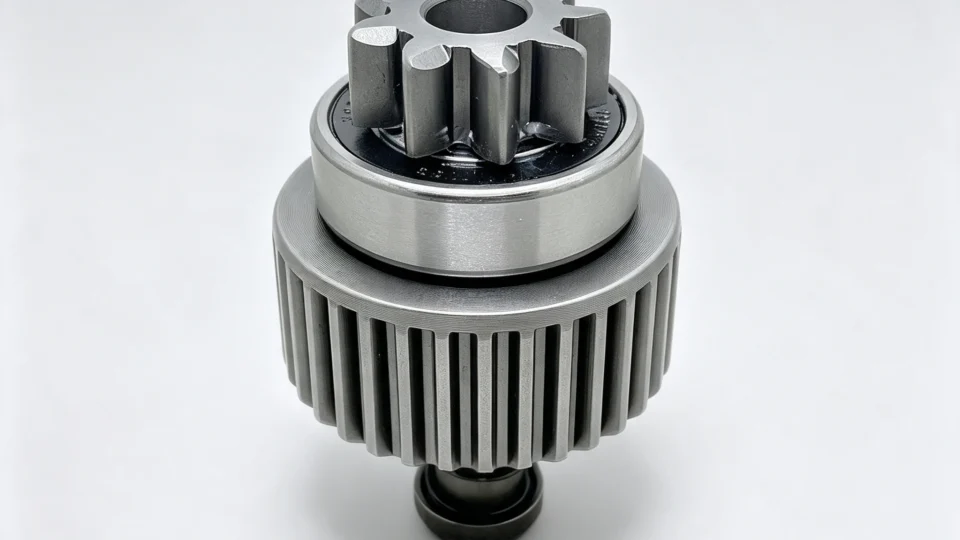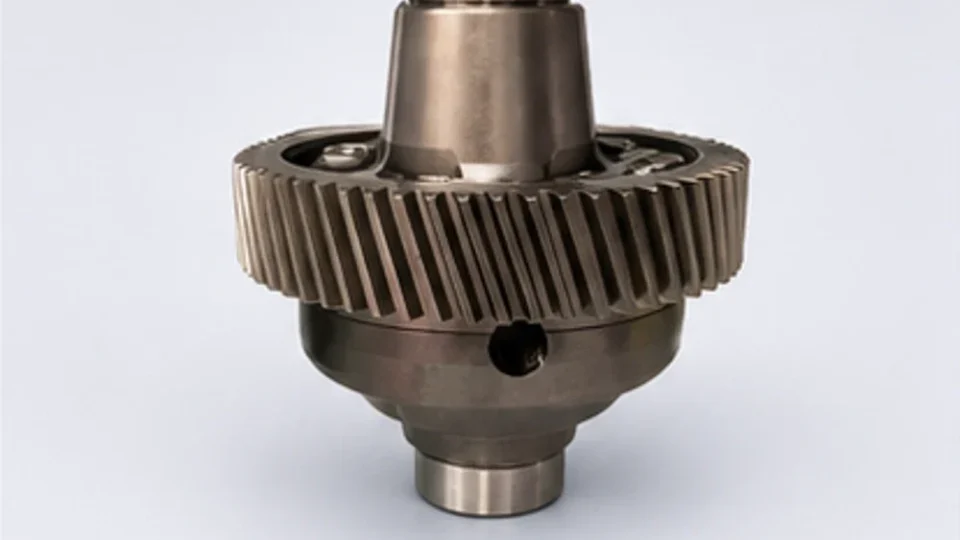



When a starter motor spins but the engine does not crank, the problem is often not the motor itself. A worn pinion gear, incorrect tooth profile, excessive shaft clearance, or a weak overrunning clutch can prevent reliable engagement. The result is grinding noise, intermittent starting, premature wear, and costly returns. For distributors and garage buyers, the bigger problem is inconsistent quality between batches. A starter drive may look correct but still fail under starting torque. That is why selecting the right gear geometry, shaft dimensions, clutch performance, material strength, and rotational direction matters. A dependable starter drive must engage smoothly, transmit high starting torque, then protect the starter immediately after the engine fires.
A starter drive works by moving or engaging a pinion gear with the engine flywheel or flexplate, transmitting starter torque during cranking, and using an overrunning clutch to prevent engine speed from driving the starter after ignition. Pan Nation focuses on precision-machined starter drives with controlled dimensions, durable materials, and OEM/ODM customization for 12V and 24V applications.

Understanding the mechanism makes product selection much easier. The following sections explain how the drive engages, how the overrunning clutch protects the starter, which starter-drive types are common, and which technical dimensions should be checked before purchasing.
1.How Does a Starter Drive Work?
Pinion Gear Engagement: The First Critical Step
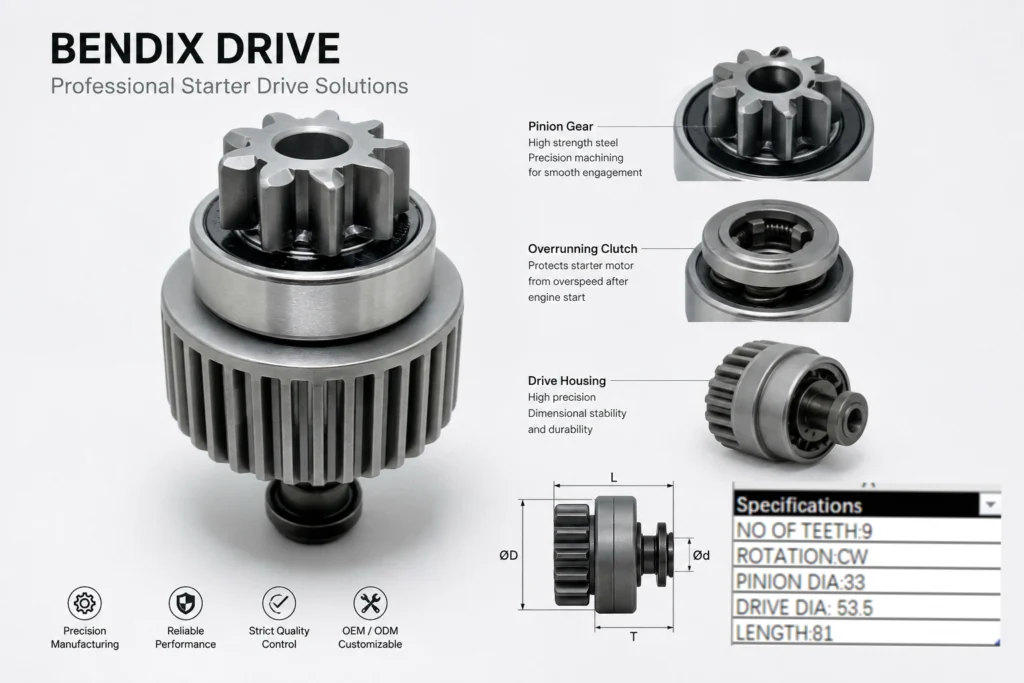
The starter drive is the mechanical interface between the starter motor and the engine. When the starting circuit is activated, the starter motor produces rotational torque. The drive mechanism positions the pinion gear so that its teeth engage with the engine’s ring gear.
The tooth profile is critical. A correctly manufactured pinion must match the mating ring gear in tooth count, pitch, pressure geometry, outside diameter, and engagement depth. If these parameters are incorrect, the gears may only partially engage. This can create tooth impact, noise, accelerated wear, or failure to crank the engine.
Precision machining also matters at the shaft interface. The technical product references show typical starter-drive configurations with 8–12 pinion teeth, 28–46 mm pinion outside diameter, and 8–17 mm shaft diameter. These are reference ranges, not universal specifications; the actual dimensions must match the starter and vehicle application.
- Tooth profile: determines engagement quality.
- Pinion diameter: affects gear compatibility.
- Shaft diameter: controls fit with the starter armature or drive shaft.
- Material and heat treatment: influence wear resistance and service life.
- Dimensional accuracy: reduces vibration and inconsistent engagement.
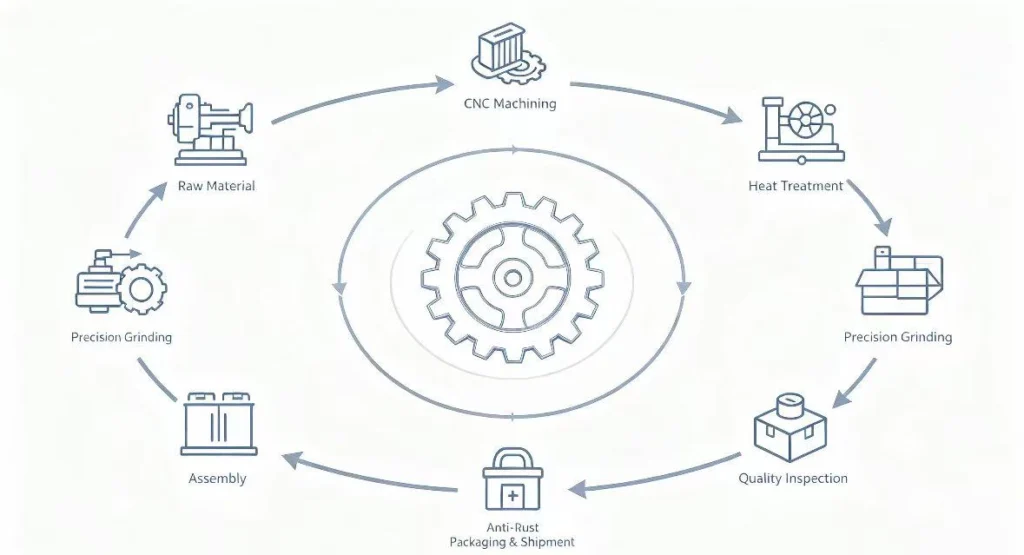
For a professional Manufacturer or Supplier, these dimensions should be controlled during production rather than checked only after assembly. Pan Nation’s product references emphasize precision manufacturing, strict inspection, and reliable engagement as key quality requirements.
2. What Is the Working Principle of an Overrunning Clutch?
The second key component is the overrunning clutch, sometimes called a one-way clutch. Its job is simple but essential: transmit torque from the starter to the engine during cranking, while preventing the running engine from driving the starter motor at excessive speed.
During starting, torque flows from the starter motor through the drive assembly to the pinion gear. The clutch locks in the driving direction, allowing the pinion to transmit torque to the engine ring gear.
Once the engine starts, the engine can rotate much faster than the starter motor. At this point, the clutch must overrun. Instead of transmitting reverse torque back into the starter motor, the internal clutch mechanism allows relative rotation. This protects the starter from overspeed damage.
This function is especially important because the starter motor is designed for short-duration cranking, not continuous operation at engine speed. A properly functioning clutch therefore contributes directly to starter durability and system reliability.
- Cranking phase: clutch locks and transmits starter torque.
- Engine-start phase: engine speed rises rapidly.
- Overrun phase: clutch releases relative motion and protects the starter.
The technical references specifically identify the overrunning clutch as a protection mechanism against reverse rotation and starter overspeed.
3. Common Types of Starter Drives
Starter drives are not one universal component. Different starter constructions and vehicle applications require different mechanical configurations. The most important distinction is the method used to achieve pinion engagement and torque transmission.
Overrunning-Clutch Starter Drives
These designs use a one-way clutch to transmit torque during cranking and allow free overrunning after engine start. They are widely used because they provide effective starter protection and stable torque transmission.
Bendix-Type Drives
A Bendix-style arrangement uses the rotational behavior of the starter drive to move the pinion into engagement. Depending on the specific construction, the drive may incorporate a helical or threaded interface and return mechanism. Correct shaft geometry, thread or spline design, axial movement, and pinion alignment are essential.
Customized Starter Drives
For replacement and aftermarket applications, a customized drive may be necessary when the standard catalog dimension does not match the original starter. A professional OEM or ODM program can modify dimensions, tooth configuration, shaft geometry, materials, surface treatment, branding, or packaging according to the customer’s specification.
Pan Nation’s technical product references identify support for OEM / ODM customizable solutions, including customized requirements for different markets and applications.
| Technical Parameter | Typical Range | Application / Engineering Note |
|---|---|---|
| Pinion Teeth | 8–12 | Common range for 12V and 24V starter applications |
| Pinion Outside Diameter | 28–46 mm | Must match the application |
| Shaft Diameter | 8–17 mm | Must match the starter shaft |
| Overall Length | 52–78 mm | Varies by starter model |
These ranges are presented in the supplied technical product references as typical specifications. They should not be treated as universal replacement dimensions.
4.Which Starter Drive Dimensions Matter Most?
Gear Geometry, Shaft Fit, and Rotation Direction
For purchasing managers, simply matching a product by appearance is risky. A starter drive can have the same general shape as the original part while still having incompatible functional dimensions.
The first check should be the pinion tooth count. Next, confirm the outside diameter, shaft diameter, overall length, mounting geometry, and rotation direction. The supplied product specifications identify both CW and CCW rotation options and applications covering 12V and 24V starters.
| Parameter | Reference Specification | Why It Matters |
|---|---|---|
| Rotation | CW / CCW | Must correspond to starter operating direction |
| Application Voltage | 12V / 24V | Indicates intended starter-system application |
| Pinion Teeth | 8–12 | Must correspond to mating ring gear |
| Shaft Diameter | 8–17 mm | Determines shaft compatibility and fit |
For distributors, this information should be included in the purchasing specification before quotation. It reduces the risk of ordering a visually similar but mechanically incompatible product.
5.How Do Material and Manufacturing Quality Affect Starter Drive Life?
High-Strength Steel and Precision Manufacturing
A starter drive operates under a demanding load cycle. The pinion must transmit high starting torque while repeatedly engaging and disengaging with the engine ring gear. Poor material selection or insufficient heat treatment can lead to tooth wear, deformation, surface damage, and premature failure.
The supplied product references emphasize high-strength steel, precision machining, accurate tooth profiles, and heat treatment for improved wear resistance. They also identify the drive housing as a precision-machined component requiring high rigidity, load capacity, and dimensional stability.
Quality control should cover more than visual inspection. A capable factory should control critical dimensions and functional performance throughout production. Important checks include:
- Pinion tooth dimensions and profile
- Shaft diameter and concentricity
- Overall length and assembly dimensions
- Clutch engagement and overrunning function
- Surface condition and machining quality
- Functional performance before shipment
The product materials supplied for this article describe 100% inspection on key dimensions and functional performance as part of the stated quality-control approach.
6.How Should Distributors Select a Starter Drive Supplier?
Compatibility, Consistency, and Supply Capability
For B2B buyers, the lowest unit price is rarely the most important factor. The real cost appears when a starter drive fails after installation, causes a return, or creates uncertainty across multiple batches.
A reliable Supplier should provide clear technical parameters before quotation. Ask for the tooth count, outside diameter, shaft diameter, overall length, rotation direction, application voltage, material specification, and inspection method.
For repeat orders, consistency is equally important. The second shipment should perform like the first. This requires controlled tooling, stable machining processes, inspection standards, and traceable production procedures.
Customization is another important consideration for importers and distributors. A factory capable of OEM, ODM, and Customizable production can support private-label programs, application-specific dimensions, and different market requirements. The supplied Pan Nation product materials explicitly position the product line around OEM/ODM customization and factory-direct supply.
For professional buyers, the best sourcing process is straightforward:
- Provide the original starter-drive sample, OE number, drawing, or complete dimensions.
- Confirm pinion tooth count and gear geometry.
- Verify shaft dimensions and rotation direction.
- Confirm clutch function and application voltage.
- Request a sample or pre-production approval.
- Define inspection requirements before mass production.
7.Why Does Starter Drive Precision Matter for Long-Term Performance?
From Engagement to Overrunning: One Complete Working Cycle
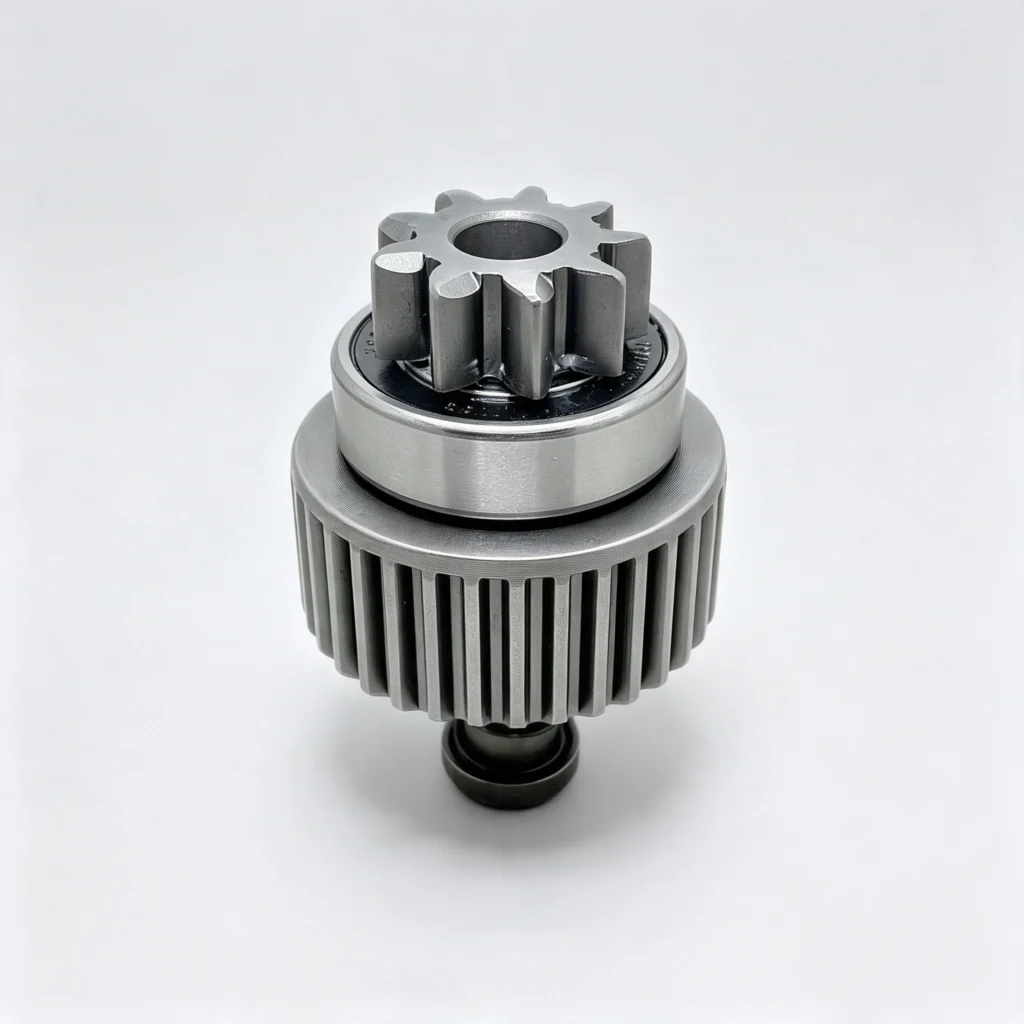
The working cycle can be understood in three stages. First, the starter drive establishes mechanical engagement between the pinion and engine ring gear. Second, the locked clutch transmits torque so the starter can crank the engine. Third, after combustion begins and engine speed increases, the overrunning clutch allows the engine to rotate without forcing excessive speed back into the starter.
Every stage depends on accurate component geometry. If the pinion does not engage correctly, torque transmission becomes unstable. If the clutch does not lock reliably, starting torque may be lost. If the clutch does not overrun correctly, the starter can be exposed to damaging overspeed.
This is why starter-drive quality should be evaluated as a complete mechanical system rather than as a simple replacement gear. Precision machining, material strength, dimensional stability, clutch performance, and application compatibility all contribute to reliable starting performance.
For distributors, garages, and starter manufacturers, this approach also makes troubleshooting more systematic. Instead of asking only whether the drive “fits,” ask whether it meets the required mechanical specifications and performs correctly throughout the complete starting cycle.
Conclusion: Choose the Starter Drive by Engineering Data
A starter drive is a small component with a critical mechanical role. Correct gear geometry, shaft fit, clutch function, material quality, and dimensional control determine performance. If you need a reliable Manufacturer for standard or OEM/ODM Customizable starter drives, contact Pan Nation for technical matching and bulk supply.